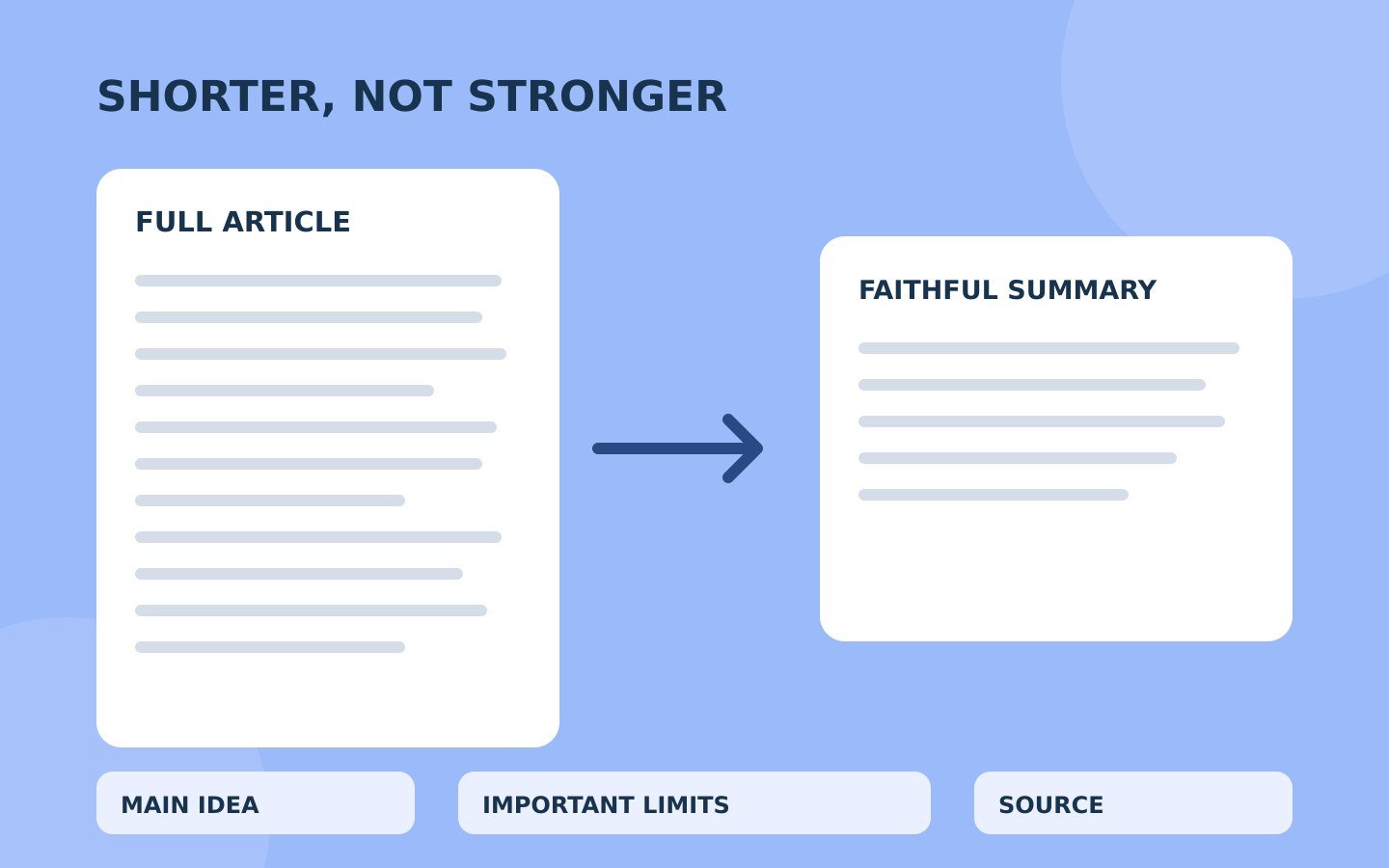
A summary can be short, readable and still misleading. The problem often appears when the writer removes the conditions that made the original statement accurate. “This approach may help teams with a shared review process” becomes “This approach helps teams.” The sentence gets cleaner while the meaning becomes broader than the source supports.
A useful article summary preserves the central idea, its important boundaries and the reader’s route back to the original. It does not need to reproduce every example. It does need to avoid creating a stronger conclusion than the article actually reaches. The following method is intended for website editors, newsletter writers and anyone condensing an explanatory article into a shorter standalone account.
Decide what the summary must do
Begin with the placement and reader. A summary at the top of an article helps readers orient themselves before continuing. A summary in a newsletter may be the only account they see. An internal summary may help a colleague decide whether the original is relevant to a project. These situations require different amounts of context.
Write a purpose statement before drafting: “This summary will help a first-time reader understand the article’s main recommendation and decide whether to read more.” Use that statement to reject unrelated detail. Do not make the summary serve several competing purposes, such as explaining the source, promoting a service and presenting your own opinion, without distinguishing them.
Choose a provisional length rather than treating a word limit as the only measure of quality. If the available space cannot accommodate an essential qualification, narrow the claim or choose a different angle. Cutting the qualification while keeping the stronger claim is not a successful editing solution, even when the result fits neatly into a card.
Read for the argument, not just attractive lines
Read the complete article before writing its summary. Headings, introductory promises and highlighted quotations may suggest its direction without representing its final argument. Notice whether later sections narrow an early claim, explain exceptions or acknowledge unresolved questions. Those details can change how the opening should be understood.
Purdue OWL distinguishes summarizing from quotation and paraphrase: a summary presents the main ideas in the writer’s own words and still requires attribution. That distinction is useful for editors. A collection of lightly reworded sentences is not automatically a coherent account of what the whole article says.
Make a short private map of the source: its question, main answer, supporting reasoning and meaningful limits. Do not copy complete sentences into this map unless you deliberately intend to quote them later. Working from the structure of the argument helps you decide which examples support the main point and which are incidental.
Identify the conditions that cannot disappear
Look for language about audience, setting, timing and degree of certainty. Does a recommendation apply to beginners, a particular workflow or a limited kind of material? Does the author describe a possibility, an observed association or a demonstrated effect? Preserve the distinctions that would change a reader’s decision or interpretation.
Imagine an illustrative article recommending a shared terminology list for a team that repeatedly edits the same technical documents. “Use a glossary to improve all business writing” is too broad. A more faithful summary says the article recommends a shared terminology list for teams that need consistent wording across recurring technical documents. The second version retains the relevant setting.
Not every caveat deserves equal space. A minor aside about the author’s preferred note-taking format may be dispensable. A statement that the advice does not cover regulated documentation may be central. Ask what a reasonable reader might do differently if the omitted detail were restored. That question is more useful than preserving every qualifying word mechanically.
Draft without borrowing the source’s sentence pattern
Close or move away from the source and explain its central idea from your notes. This encourages a genuine synthesis rather than a line-by-line substitution exercise. Keep the vocabulary needed for accuracy, especially established technical terms, but build your own sentence structure. Return to the original afterward to check meaning, not to imitate its rhythm.
Lead with the main point rather than a vague introduction such as “This article discusses several important issues.” Name the issue and the author’s answer. If a recommendation depends on a sequence, preserve that sequence. If the source compares alternatives without choosing a universal winner, do not invent one to make the summary sound decisive.
Use verbs that match the source’s activity. An article may propose, explain, report, compare or question something. Those verbs are not interchangeable. “Proposes a workflow” does not mean “proves the workflow works.” Clear attribution helps readers understand whose reasoning they are reading and how much evidence the summary is claiming.
Keep your interpretation separate
A summary can sit beside editorial commentary, but readers should be able to distinguish the two. First represent the article fairly. Then label your own application or response. “For our team, this suggests…” signals a different kind of statement from “The article concludes…” Mixing them can make a source appear to endorse a decision it never addressed.
Do not attach unsupported benefits to make the summary more appealing. If an article describes an editing method, avoid adding claims about revenue, rankings or productivity unless the source supports those exact claims and their relevant limits. An interesting process does not need a fabricated outcome to deserve a reader’s attention.
When factual clarification is needed, consult the original evidence rather than smoothing uncertainty away. If the source includes an unclear explanation from an expert, the approach in interviewing a subject-matter expert can help frame a precise follow-up question. A summary should not conceal a gap that the longer article has not resolved.
Run a claim-by-claim comparison
Place the summary next to the original and check each substantive sentence. Identify the passage that supports it. Confirm that the summary preserves the original scope, degree of certainty and direction of the claim. Pay particular attention to negatives: removing “not always” or overlooking an exception can reverse the practical meaning.
Check quantities, dates and categories independently. If the summary does not need a number, leave it out rather than rounding it casually. If a number matters, keep its unit and relevant context. Avoid combining separate statements into a new conclusion unless the source itself makes that connection or you clearly identify it as your interpretation.
Next, read the summary without the source beside it. Would a new reader know what is being summarized and where to find the full account? Use a clear source link near the attribution. A bare link at the bottom of a page may be technically present while leaving individual claims difficult to trace.
Review the shortened version as its own piece
Ask a colleague to state the main idea after reading only the summary. Compare that interpretation with the source. If they infer a universal rule where the article offered conditional advice, revise the summary before polishing its style. Accuracy is not a separate stage that ends once the sentences sound natural.
Finally, check the summary again whenever the underlying article changes. An updated source may narrow a claim, remove an example or replace a recommendation. Keep a record of the version reviewed. A good summary is a reliable small representation of a larger argument, not merely a shorter piece of writing that once resembled it.