Budgets Are Strategy in Numeric Form
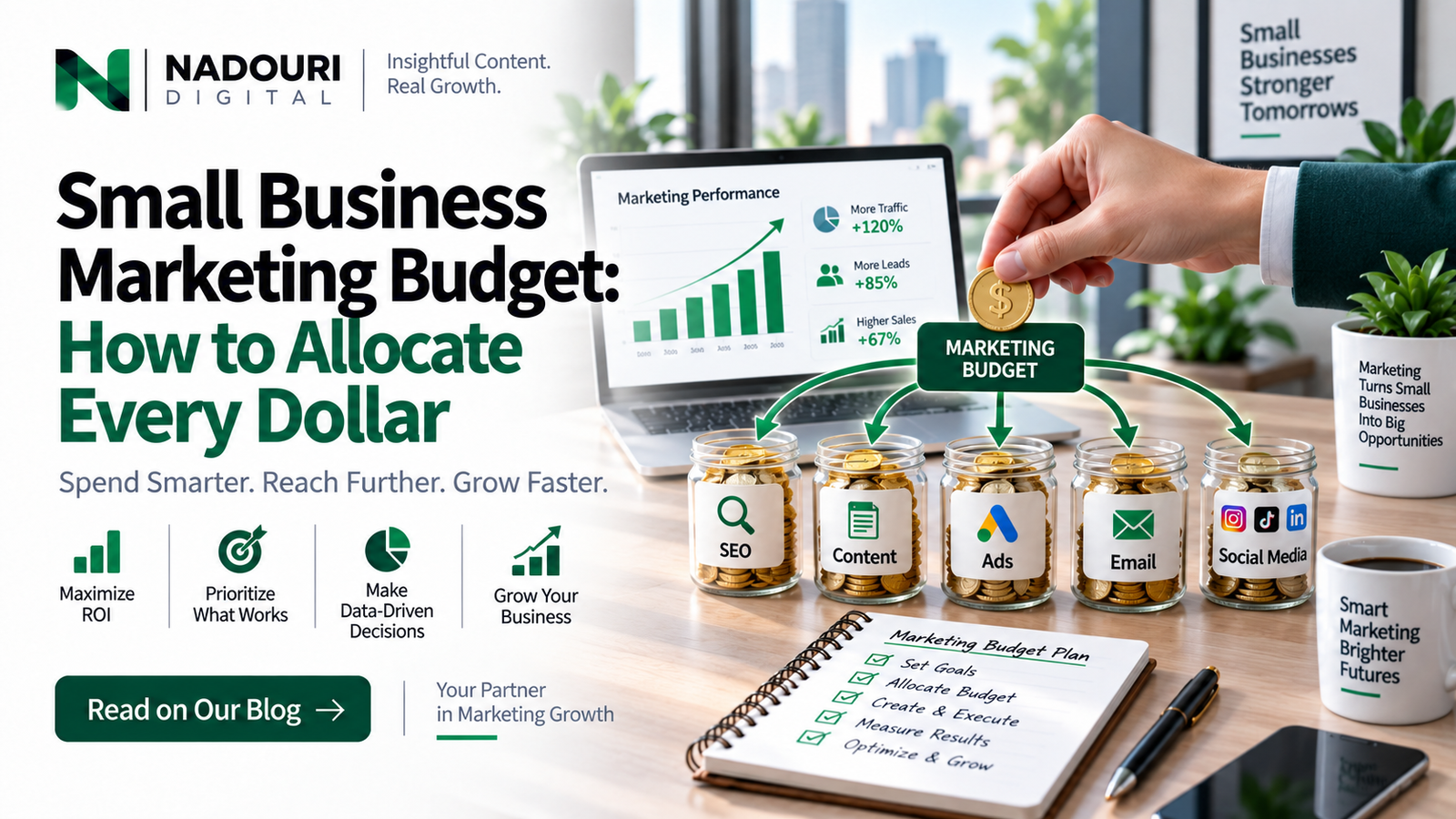
A marketing budget is not an expense plan; it is a bet allocation. Every dollar says “this channel will return more than the alternatives,” and small businesses cannot afford those bets to be wrong for long. The goal of budgeting is not spreading money evenly across everything that sounds good — it is concentrating limited funds where evidence says your specific customers actually are.
The Foundation Before the Campaigns
Before any channel spend, three foundations must exist or every dollar leaks: a fast, conversion-ready website (the destination all channels share), basic analytics (the ability to see what works), and an email capture mechanism (the owned asset all channels should feed). Skipping foundations to buy traffic is paying to fill a bucket with holes — the most common and most expensive small-business marketing mistake.
The 70/20/10 Allocation
A proven small-business split: 70 percent to proven performers — the one or two channels already demonstrably producing revenue, deepened rather than diluted; 20 percent to growth bets — adjacent channels with evidence of fit, scaled carefully; 10 percent to experiments — new channels and creative tested with money you can lose without pain. The ratio forces honest classification: most businesses discover they have been funding experiments with core budget and starving the channels that actually pay.
A service business at $3,000 monthly: $2,100 to SEO content and Google Business Profile (proven), $600 to email automation (growth bet), $300 to testing short-form video (experiment). Next quarter’s data reclassifies each.
Channel Priorities for Tight Budgets
When the budget forces choices, small-business channels rank roughly by durability of return:
- Email marketing — highest ROI, owned audience, costs almost nothing to run
- SEO content — slow to start, compounds for years, highest long-term ceiling
- Google Business Profile and local SEO — free to set up, dominates local intent
- Paid search on high-intent terms — immediate but rented; use to bridge while SEO builds
- Organic social — worth it only with a conversion path to email or site
- Paid social — powerful for proven offers, dangerous as a first bet
Sequencing: The Order Matters
Budget timing follows a reliable arc. Phase one: foundations and the owned asset (site, analytics, email). Phase two: one compounding channel (SEO content or local SEO) plus one immediate channel (paid search or outreach) to fund the wait. Phase three: reinvest compounding returns into the growth bets that earned promotion. The businesses that fail at marketing rarely pick wrong channels — they fund all channels simultaneously at levels too thin for any to work.
Reviewing and Reallocating
Budgets decay: channels saturate, costs inflate, audiences shift. Review quarterly with three questions per channel — what did it return, what is the trend, and what would the next dollar here buy versus elsewhere? Reallocate ruthlessly toward demonstrated return. A budget reviewed quarterly is a steering wheel; a budget set annually is a hope.
Conclusion
Small-business marketing budgets work through concentration and sequencing: fix the foundations, fund one compounding channel properly, bridge with one immediate channel, test cheaply, and reallocate quarterly on evidence. Nadouri Digital LLC fits the compounding line of that budget — SEO content and copywriting that keep returning long after the invoice is paid.