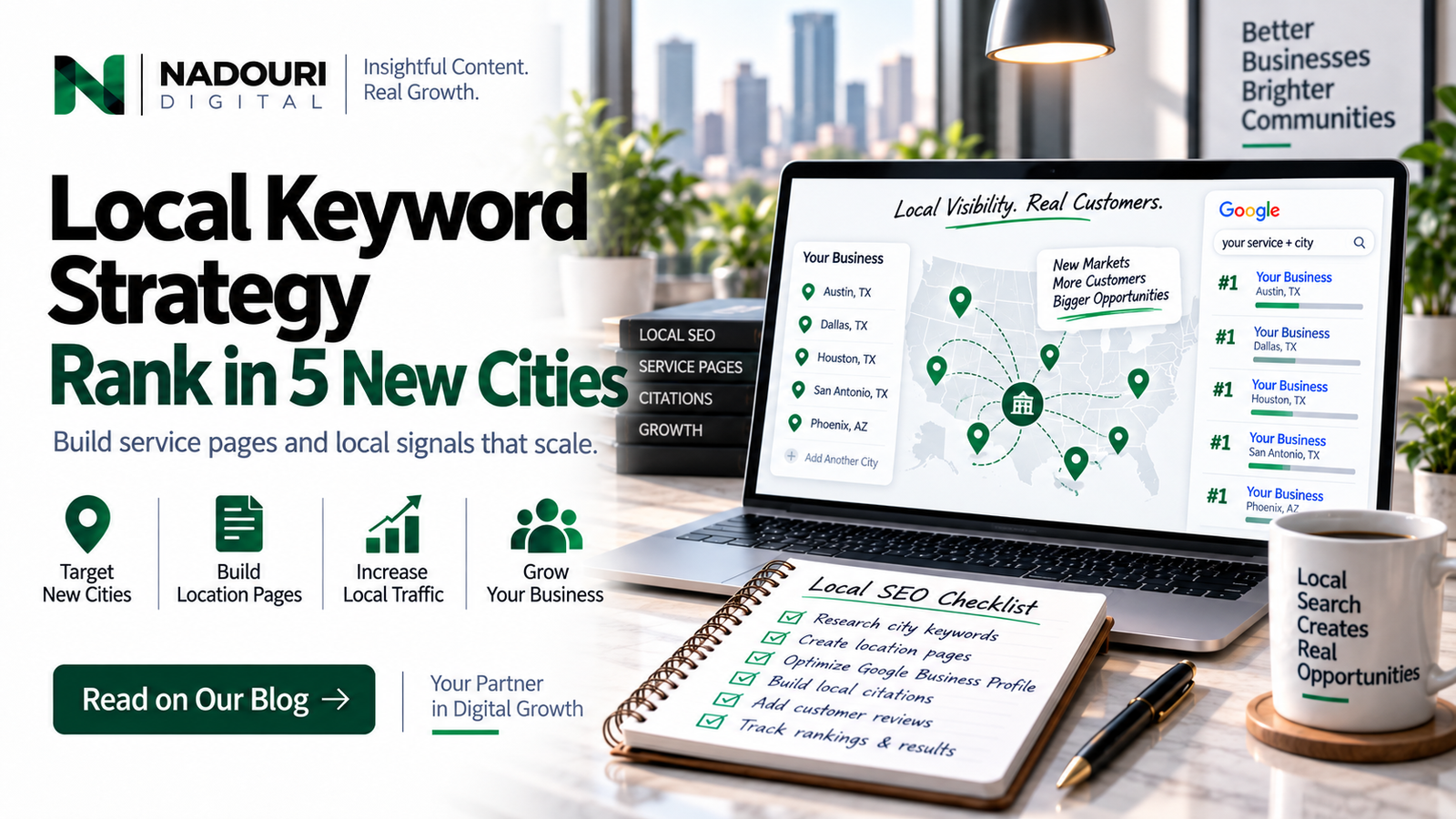
The Service-Plus-City Pattern
Local search is dominated by one query shape: service plus place. “Content writing agency London”, “SEO services Manchester”, “copywriter near me”. If you serve five cities, you need to be visible for five times your service count of these queries — and that visibility is built with dedicated pages, not a single contact page listing everywhere you work.
Researching Local Keywords
Start with your service list and multiply it by your locations. Validate with keyword tools, but trust autocomplete heavily — local volumes are often too small for tools to register, yet the searches are real and convert at the highest rate of any traffic you will earn. Check the current results for each combination: if the top results are thin directory pages, the opportunity is wide open.
Building Location Pages That Rank
Each location page must justify its existence with unique, genuinely local content. The structure that works:
- Headline — service plus city, stated plainly
- Local intro — your experience and presence in that specific area
- Services offered there — with local details where they differ
- Local proof — case studies, clients or projects from that city
- Reviews from customers in that location
- Area-specific FAQ — pricing, coverage, turnaround for that market
- Clear local call to action
Avoiding the Doorway-Page Trap
Google explicitly penalizes “doorway pages” — near-duplicate pages created only to catch location queries. The line is uniqueness: if swapping the city name is the only difference between two pages, they are doorway pages. Real local proof, area-specific FAQs and genuinely different copy per page are what keep location strategies safe. Three excellent location pages beat thirty duplicated ones.
A page for “SEO content writing in Bristol” can reference the city’s agency scene, local client work and Bristol-specific FAQs. A page for Leeds gets its own equivalents. The content differs because the work differs — uniqueness is a byproduct of honesty.
Linking the Structure Together
Location pages need internal links to rank: from your services pages, your footer’s service areas, and local blog content. Build a clean hub — one “Areas We Serve” page linking to each location — and keep URLs short and consistent: /locations/city or /city-service patterns both work when applied uniformly.
Conclusion
Local keyword strategy is multiplication with discipline: service × city, unique page per combination, real local proof, clean interlinking. Done right it produces the highest-converting organic traffic available to a service business. Nadouri Digital LLC writes location pages that pass the uniqueness test — researched per market, never templated.