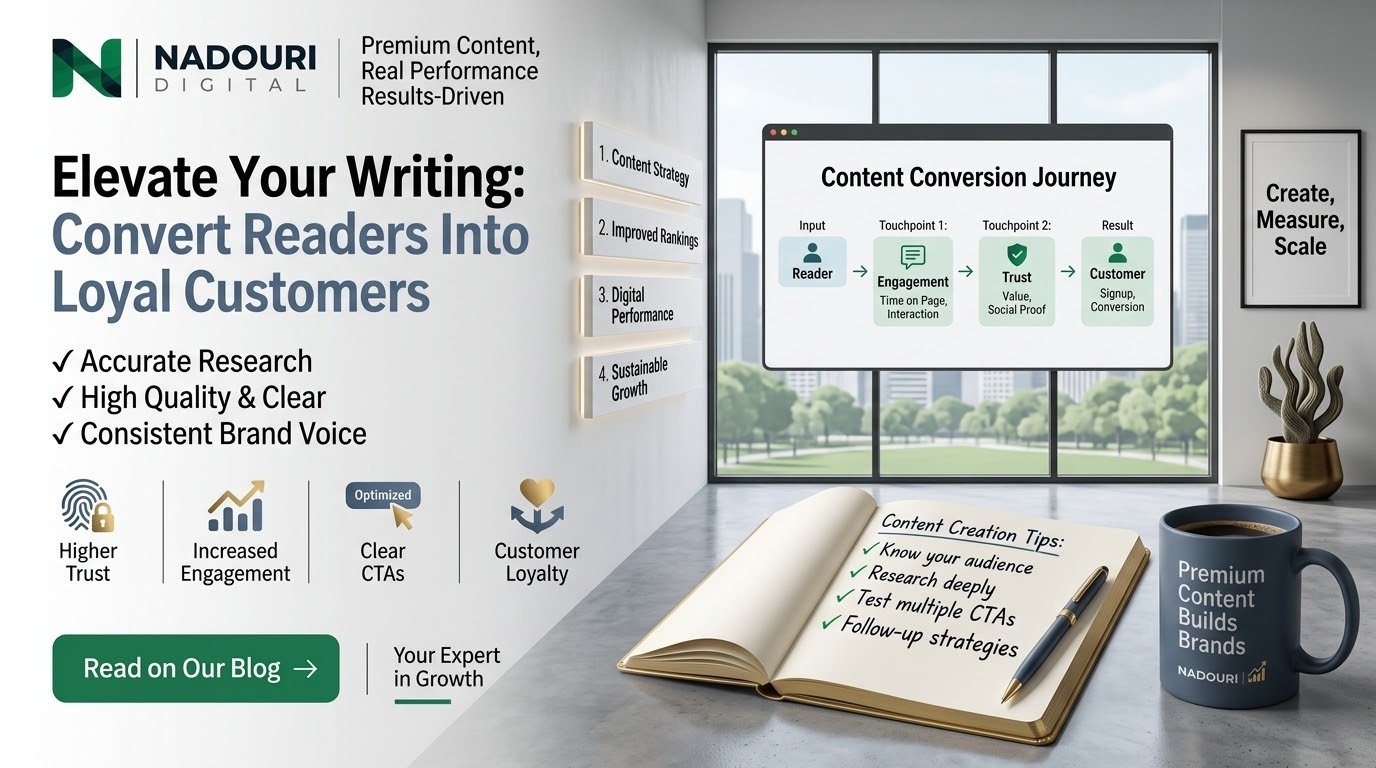
Why Most Content Fails to Convert
Most business content is written to inform. Informing is necessary, but it is not sufficient — a reader can learn everything from your article and still buy from a competitor. Converting content does one thing differently: it is engineered around a decision. Every section either builds desire, removes doubt, or moves the reader one step closer to acting.
The good news is that conversion is a craft, not a talent. It follows a repeatable framework you can apply to any page, article or email.
Step 1: Know the Reader’s Real Problem
Conversion begins before writing. Collect the exact phrases your customers use to describe their problem — from sales calls, reviews, support tickets and search data. When your headline mirrors the reader’s own words, attention is automatic.
Step 2: Lead With Benefits, Support With Features
Features describe what something is; benefits describe what the reader gets. “1,000-word SEO article” is a feature. “A page that ranks, reads beautifully and brings you customers while you sleep” is a benefit. Strong content translates every feature into a benefit before presenting it.
Feature: “Two revision rounds included.” Benefit: “You approve every line before it goes live — no surprises, no extra invoices.”
Step 3: Build Proof Into the Copy
Claims convert when they are backed by evidence. Weave proof throughout the page rather than confining it to a testimonial section:
- Specific numbers — “grew organic traffic 210% in eight months”
- Named scenarios — the client type, the starting point, the outcome
- Process transparency — show how the work is done, step by step
- Guarantees — revisions, originality checks, delivery windows
Vague superlatives (“best quality”, “world-class”) create doubt. Specifics create belief.
Step 4: Answer Objections Before They Are Asked
Every reader carries silent objections: Is it worth the price? Will it work for my industry? What if I don’t like the result? List the five most common objections to your offer and answer each one inside the copy — in a FAQ, a comparison table, or a single confident sentence placed exactly where the doubt arises.
Step 5: One Page, One Call to Action
Pages that ask for everything get nothing. Decide the single next step — order, subscribe, book a call — and repeat that one action at natural decision points: after the first proof block, after the objection handling, and at the end. Make the button copy specific: “Order My SEO Article” outperforms “Submit” every time.
Conclusion
Conversion-focused content is not pushy — it is helpful copy with a destination. Know the reader, lead with benefits, prove every claim, answer objections and guide to one clear action. Apply this framework consistently and your content stops being a cost center and starts being a sales team. Nadouri Digital LLC writes content to exactly this standard — researched, benefit-led and built to convert.