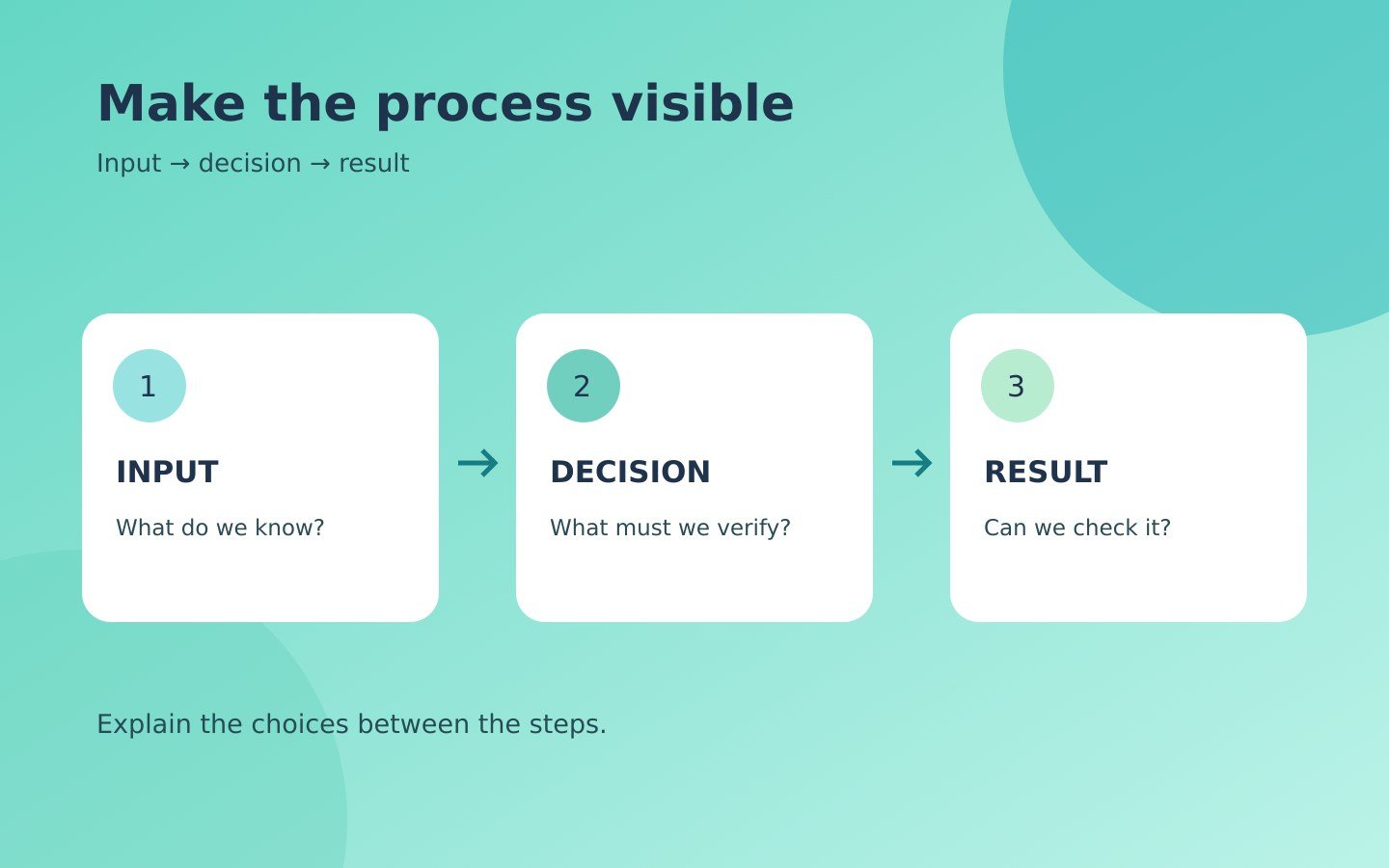
A process can sound clear to its author and still leave a reader unable to begin. “Review the information, identify the issue and choose a solution” describes a sequence, but it does not show what any of those decisions looks like. A worked example makes the invisible parts visible by following one realistic case from its starting point to a checkable result.
The aim is not to make every task appear effortless. It is to explain what information matters, why a choice is made and how the reader can tell whether to continue. The method below is an editorial approach for business articles, help pages and educational content. All scenarios are hypothetical, not claims about client work.
Choose one task with a visible finish
Start with a task narrow enough to complete in the article. “Improve a website” is too broad. “Turn a vague support question into a useful FAQ answer” is more manageable. The second task has inputs, decisions and an output a reader can inspect without following several unrelated projects.
State the finish in practical terms. In the FAQ example, the output might be a short answer that explains a condition and points to the relevant policy. It is not a promised increase in sales or a guaranteed search ranking. Distinguish an observable deliverable from a business outcome that depends on many other factors.
Write down what the example deliberately leaves out. A small help-page example does not need to cover every policy exception or account type. Naming the boundary prevents an illustrative case from being mistaken for a complete operating procedure.
Establish the starting conditions
Give readers the information they need before the first action. Identify the situation, relevant constraints and material available. If a hypothetical support question is “When will it arrive?”, explain that the business sells a digital document and delivery occurs after a successful purchase. Otherwise the example may accidentally drift into physical shipping advice.
Do not add facts just because they make the story more vivid. An invented delivery guarantee, customer quotation or revenue number can make an example look like evidence. Label invented scenarios clearly and keep the illustrative details limited to those needed to understand the process.
For technical examples involving contact details, Google's guidance on example domains and names recommends avoiding real personal information and using suitable example data. A placeholder such as example.com can demonstrate a format without involving an unrelated person's real address. The same caution applies to screenshots and sample records.
Show the first decision before the first rewrite
Explain what you notice in the input. In our hypothetical FAQ task, “When will it arrive?” leaves several possibilities open: when payment completes, when access becomes available and how the customer finds the file. Jumping directly to a polished answer hides the analysis the reader needs to learn.
Instead, write the decision explicitly: the question is about access to a digital purchase, so the answer must explain the delivery route and the condition that starts it. The writer then checks the actual purchase process and policy. If that information is unavailable, the next step is verification, not creative wording.
This is where a worked example earns its space. The reader sees how a broad phrase becomes a specific information requirement. They can apply the reasoning to another question instead of copying a sentence that may not fit their service.
Keep the sequence visible
Use headings or numbered steps for actions that must happen in order. Each step should explain one main action and its immediate result. Avoid packing research, rewriting, legal review and publication into a single instruction called “finalise the answer.” Those activities may have different owners and require different evidence.
A practical sequence for the FAQ example is to identify the question, verify the delivery route, draft the answer and test it against the actual interface. The sequence should not imply that the website has been changed merely because the wording has been prepared. Content readiness and implementation are separate checks.
The W3C's headings guidance describes headings as a way to communicate organisation. Use meaningful section labels rather than decorative phrases. “Check what happens after payment” tells a reader more than “The magic moment.” Preserve a logical structure when the article is published.
Explain why each choice was made
A useful example includes reasoning, but not every thought the author had. Focus on decisions that someone else could reasonably get wrong. If the answer uses “download” rather than “delivery,” explain that the customer receives a file rather than a parcel. If the wording avoids an exact time, explain that no verified timing commitment is available.
Do not present a style preference as a universal rule. A short answer may work in a compact FAQ, while a separate help article may require screenshots and troubleshooting. Tell the reader which situation the choice serves. This makes the guidance more flexible and less likely to be misapplied.
When two approaches are reasonable, show the trade-off briefly. A direct link to a policy can keep an answer short, but the answer must still provide enough context to be useful on its own. Repeating an entire policy may make the FAQ harder to maintain.
Include one meaningful complication
An example that contains no uncertainty can teach a misleading version of the task. Add one realistic complication that changes the next action. For instance, the writer discovers that the download link appears in the account area, while an older help page says it arrives only by email.
The appropriate response is to check the current behaviour with the responsible person or a permitted test. Do not choose whichever sentence sounds simpler. The example can show the conflict being recorded and the draft held until the correct route is confirmed. That demonstrates responsible work without inventing an operational result.
Avoid piling on exceptions. One complication can teach a decision boundary; several unrelated failures can overwhelm the main lesson. Offer a separate troubleshooting resource if the reader needs a wider catalogue of cases.
Make the finished example inspectable
After showing the process, present the output with its assumptions visible. A hypothetical answer might explain that a file becomes available in a customer's account after payment succeeds, but only if that behaviour has been verified for the example system. Do not invite readers to copy such a promise into a real store unchecked.
Then run a small review against the starting question. Does the answer say where to look, what condition must be met and what to do if access is missing? Are labels consistent with the interface? Has a claim appeared in the final wording that was absent from the verified inputs?
The check is part of the lesson, not a ceremonial final step. Show how a reader could find an error. A polished paragraph without a test teaches presentation; a paragraph with a transparent check teaches a reusable method.
Help readers transfer the method
Close by identifying what stays the same in another situation and what must change. The general pattern is to define the task, inspect the inputs, verify missing facts, explain the decisions and check the result. The actual delivery method, terminology and policies belong to the particular business.
For a different example, a service provider could explain how to turn interview notes into an article outline. The inputs would change, but the need to distinguish verified information from assumptions would remain. See the guide to interviewing a subject-matter expert for related preparation.
A worked example succeeds when readers understand the decisions well enough to adapt them. Keep the scope honest, the evidence visible and the finish testable. Those choices are more useful than adding an impressive outcome that the example cannot substantiate.