Why Readers Abandon Good Articles
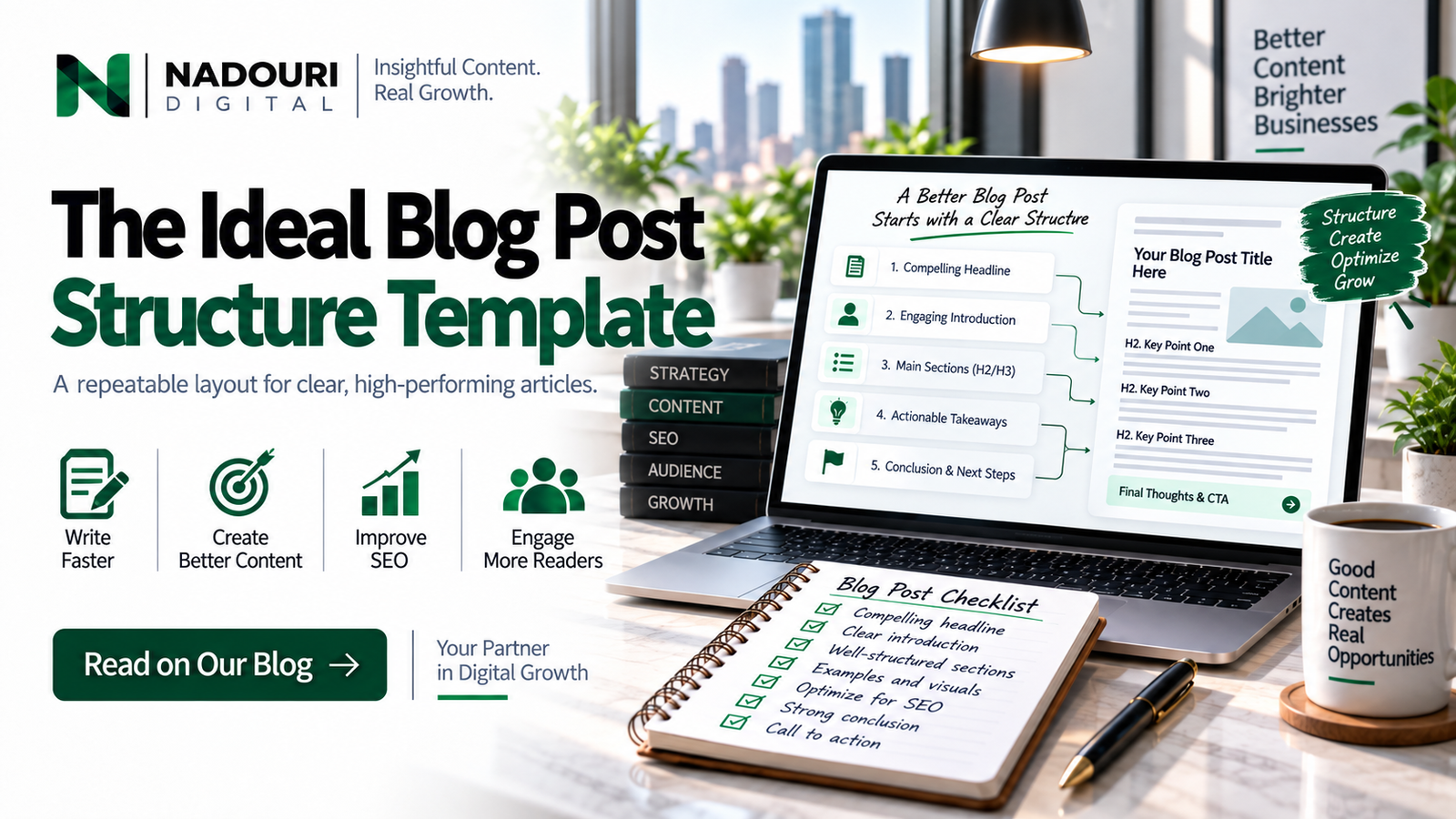
Most articles are abandoned not because the information is wrong but because the structure is invisible. Readers arrive with a question, scan for ten seconds, and leave if they cannot see where their answer lives. Structure is what makes an article navigable — and navigability is what gets it finished, shared and ranked.
The Template
- Hook — one to three sentences that name the reader’s exact situation
- Promise — what the reader will be able to do by the end
- Roadmap — a contents list on longer posts, doubling as snippet bait
- Body sections — one idea per H2, opened with a direct answer
- Examples and proof — every claim followed by evidence or demonstration
- Summary — three lines maximum, synthesizing rather than repeating
- Call to action — one clear next step
The Hook and the Promise
The first fifty words decide the article. Name the reader’s problem in their own words, then promise the outcome concretely. “Your product descriptions are costing you sales — here is the formula that fixes them” outperforms any warm-up paragraph about the importance of copywriting. Get to the point; the reader is already late.
Weak: “In today’s fast-paced digital world, content is more important than ever…” Strong: “Your blog gets traffic but no enquiries. The problem is almost never the writing — it is the structure. Here is the fix.”
Section Flow and Formatting
Order sections by the reader’s journey: what they need to understand first, then next, then last. Within sections, keep paragraphs under four lines, use lists wherever items are enumerable, and bold sparingly for genuine emphasis. Each section should be skimmable alone — that is how most of your audience will actually consume it.
Endings That Work
End with synthesis and direction, not a summary parade. One paragraph tying the pieces together, one clear next step. If the article was educational, the natural CTA is the adjacent service or a related deeper guide — an offer, placed after value, that feels like a continuation rather than an interruption.
Conclusion
Hook, promise, roadmap, direct-answer sections, proof, synthesis, CTA — seven parts, every post. Structure is the difference between articles people finish and articles people bounce from. Nadouri Digital LLC writes every blog post on this template, adapted to your voice and your funnel.