“Make this stronger” is easy to type and difficult to act on. The writer has to guess whether the reviewer wants a clearer claim, a different example, more evidence or simply a more confident tone. Several rounds of revisions can follow without either person agreeing on the problem they are trying to solve.
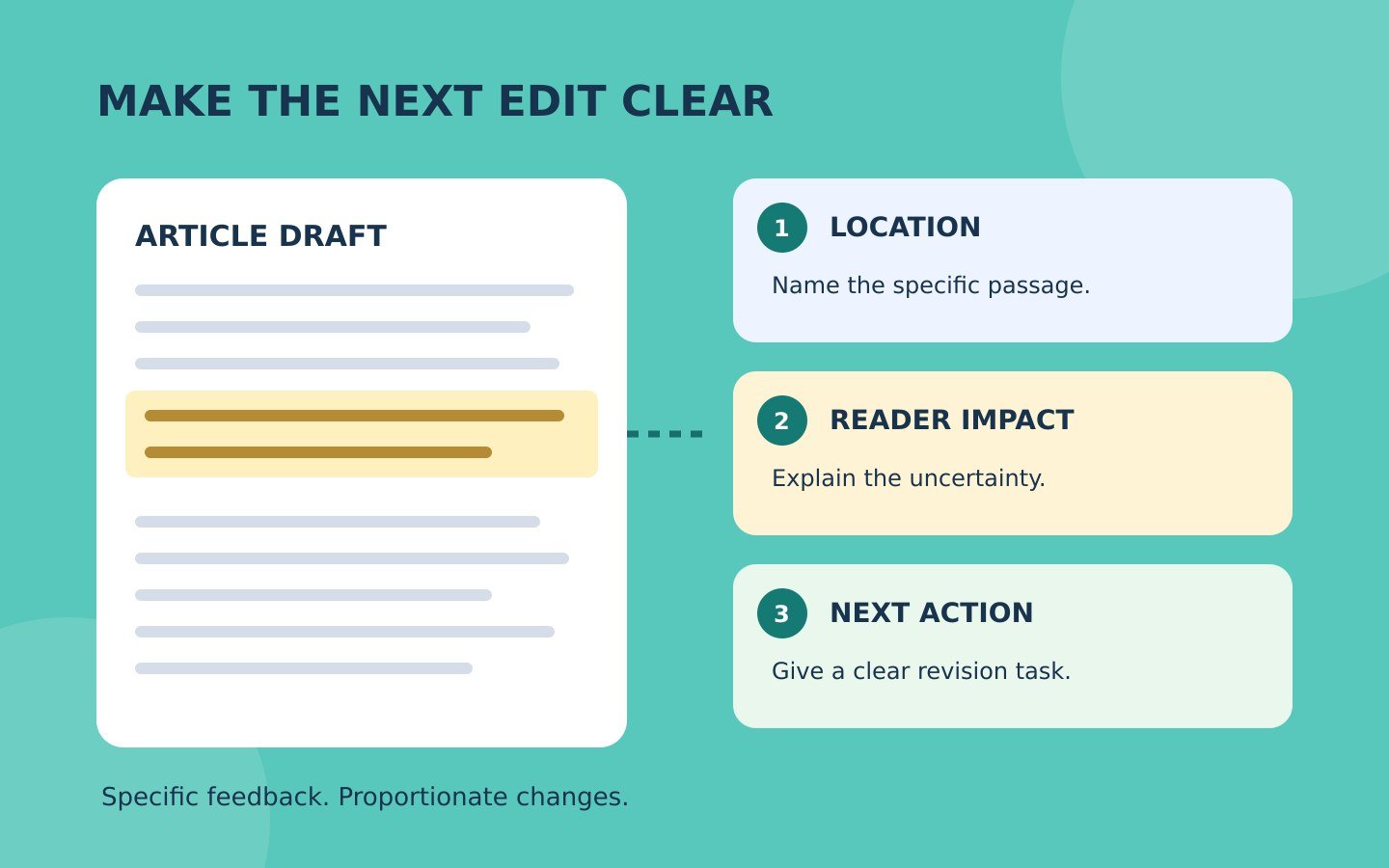
Useful content review comments turn a reader’s difficulty into a clear revision task. They identify where the difficulty occurs, explain why it matters and suggest a next step without unnecessarily taking over the writer’s voice. This guide offers a practical approach for reviewing website copy, explanatory articles and other business content in a shared document.
Agree on the kind of review first
Before leaving comments, establish what the draft is ready for. An early outline may need decisions about scope and order. A complete draft may need a check of evidence and reader understanding. A nearly approved page may need careful wording corrections. Treating every stage as a final proofreading pass can produce detailed comments on paragraphs that should not survive.
The University of North Carolina Writing Center’s guidance on getting feedback emphasizes asking specific questions and identifying the kind of response that would help at the current stage. Business teams can apply that principle by adding a short review request: “Please check whether the explanation answers a new customer’s delivery questions; wording polish comes next.”
Agree on the target reader and intended action as well. Otherwise, two thoughtful reviewers may judge the same sentence against different goals. One might want a technical explanation while the other expects a short introduction. Resolving that difference is a brief-setting decision, not something the writer should infer from conflicting margin notes.
Anchor each comment to an observable problem
Attach the comment to the smallest relevant passage. If the problem affects a whole section, say so rather than highlighting one arbitrary word. Avoid relying on location descriptions such as “the paragraph above,” which can become confusing after edits move the text. A useful anchor makes the feedback easier to revisit during the next review.
Describe what happens when you read the passage. “I cannot tell whether the delivery estimate starts at checkout or dispatch” identifies a specific uncertainty. “Confusing” merely reports a reaction. The first comment gives the writer something to investigate and resolve; the second requires a conversation before a meaningful revision can begin.
Keep the observation separate from an assumption about the writer. Say that a term has not been defined, not that the author failed to understand the audience. Reviews should assess the draft’s effect on a reader. Claims about effort, competence or intention rarely help explain what needs to change in the text.
Connect the problem to the reader’s task
Explain why the issue matters when the reason is not obvious. A paragraph may be technically correct but appear before the reader has enough context to use it. A headline may sound attractive but fail to distinguish two services. Naming the consequence helps the writer choose a revision that addresses the real problem rather than merely satisfying a stylistic preference.
For example: “These two options use the same description, so a first-time visitor cannot tell which one includes installation.” The comment connects wording to a choice the reader needs to make. It does not require the reviewer to invent product facts. The next step is to confirm the actual distinction with an appropriate owner.
Do not exaggerate the consequence to make a comment feel important. Avoid unsupported claims that one sentence will damage search performance or eliminate conversions. “The wording could be read as including installation” is a useful, testable concern. “This will destroy sales” is not a proportionate explanation of an editorial problem.
Suggest a next action, not always a replacement
The best next step depends on the issue. A typo can be corrected directly. An uncertain fact may need a source. A missing explanation may need an example. A structural problem may require moving or removing a section. Specify the kind of work needed rather than prescribing a sentence before the underlying question has been answered.
A helpful comment might read: “Please confirm when the delivery window begins, then state that trigger in this sentence.” This separates verification from writing. If the writer needs to consult a specialist, a focused subject-matter expert interview offers a way to turn the uncertainty into a specific question rather than requesting a general review.
Offer replacement wording when it genuinely reduces ambiguity, but label it as a suggestion if other solutions would work. Explain the reason behind a meaningful change. Otherwise, the writer may accept the sentence without understanding the principle and repeat the same problem elsewhere. The review should improve the current draft and make the decision understandable.
Distinguish requirements from preferences
Not every comment has the same authority. An unsupported claim, a factual contradiction and a preference for shorter sentences should not arrive with identical urgency. Use clear labels suited to the team, such as “accuracy check,” “reader clarity” and “optional wording.” Keep the system small enough that reviewers will actually use it.
Reserve mandatory language for genuine requirements. If a published style rule applies, link to it or identify it precisely. If you simply prefer one expression, say so. Calling every preference a rule makes the review harder to prioritize and can create unnecessary disagreement over changes that do not materially affect the reader.
Identify who can settle unresolved decisions. The writer may be able to improve wording but lack authority to confirm a service commitment. A review comment should not quietly transfer that business decision to them. Name the question, indicate the appropriate decision owner where known and leave the wording provisional until the answer is available.
Prioritize before sending a wall of comments
Read the whole draft before delivering detailed feedback. A later section may already answer a question you noticed earlier, in which case the issue is placement rather than missing information. Group repeated problems into a short overall note with a few examples instead of adding the same comment to every paragraph.
Start the review summary with the changes that affect meaning or structure. Explain what already works so the writer knows what to preserve, but keep praise specific. “The comparison uses the same criteria for both options” is more useful than a general compliment because it identifies a feature that should survive revision.
If several reviewers are involved, reconcile contradictory requests before asking the writer to implement them. One person asking for a shorter introduction and another requesting three new opening paragraphs may reflect an unresolved scope disagreement. Assign a decision owner rather than making the writer choose silently between incompatible directions.
Close the loop on the revision
When the writer responds, check whether the original issue has been resolved, not whether they used your exact wording. A different solution may explain the point more effectively. If the revision introduces a new factual claim, verify it rather than assuming the previous review covers the changed sentence.
Keep a short record of decisions that affect later pages, such as an agreed product term or the approved explanation of a delivery condition. Do not turn every minor edit into policy. Useful records capture repeatable decisions; the comment thread can retain local details about the individual draft.
Finally, resolve comments only after their questions are answered or deliberately deferred with a clear owner. A clean document is not proof that the content is ready. Good review feedback leaves the writer knowing what to change, why it matters and how to recognize an adequate result. That clarity is the real measure of a useful comment.