The Question Behind the Query
Every search is a person trying to accomplish something. Search intent is that underlying purpose — and Google’s entire ranking system is built to reward pages that satisfy it. This is why intent-mismatched pages do not rank no matter how well written they are: Google would rather show a mediocre page of the right type than a brilliant page of the wrong one.
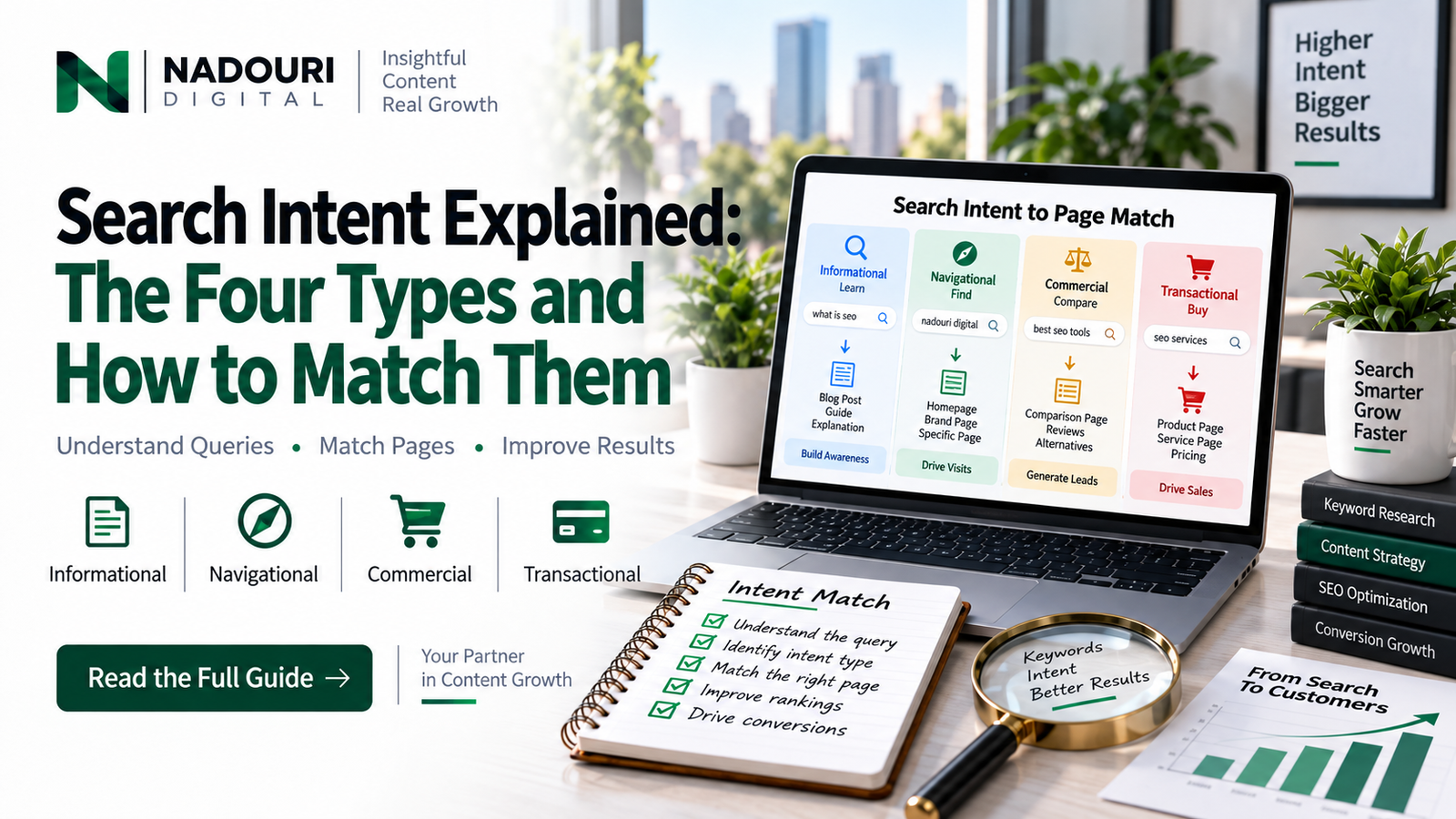
The Four Intent Types
Informational
The searcher wants to learn: “what is content marketing”, “how to write a blog post”. Serve it with guides, explainers and definitions — thorough, structured, genuinely educational.
Navigational
The searcher wants a specific destination: “Nadouri Digital pricing”. You cannot win another brand’s navigational queries; make sure you dominate your own.
Commercial investigation
The searcher is comparing options: “best SEO writing services”, “content agency vs freelancer”. Serve it with comparisons, reviews and honest “best of” content.
Transactional
The searcher is ready to act: “order SEO article writing”, “product description service price”. Serve it with service and product pages — clear offer, proof, one call to action.
Classify Any Query in Ten Seconds
Type the query into Google and read the results. The current page one is Google’s own intent classification: if it is all guides, the intent is informational; all product pages, transactional; a mix of comparisons and lists, commercial. Your page must match the dominant format to compete. This single habit — search before you write — prevents most content failures.
Mapping Intent Across Your Funnel
A complete content strategy serves all four intents deliberately. Informational articles fill the top of the funnel and build authority. Commercial content captures evaluators. Transactional pages convert. Each layer links downward — an informational guide references your comparison content, which links to your service pages — so traffic acquired cheaply at the top becomes revenue at the bottom.
Conclusion
Intent is the first classification in every content decision: informational, navigational, commercial or transactional. Match the format Google already rewards, then beat it on depth and clarity. Every brief we write at Nadouri Digital LLC begins with intent classification — it is why our content ranks for the searches that matter to your business.