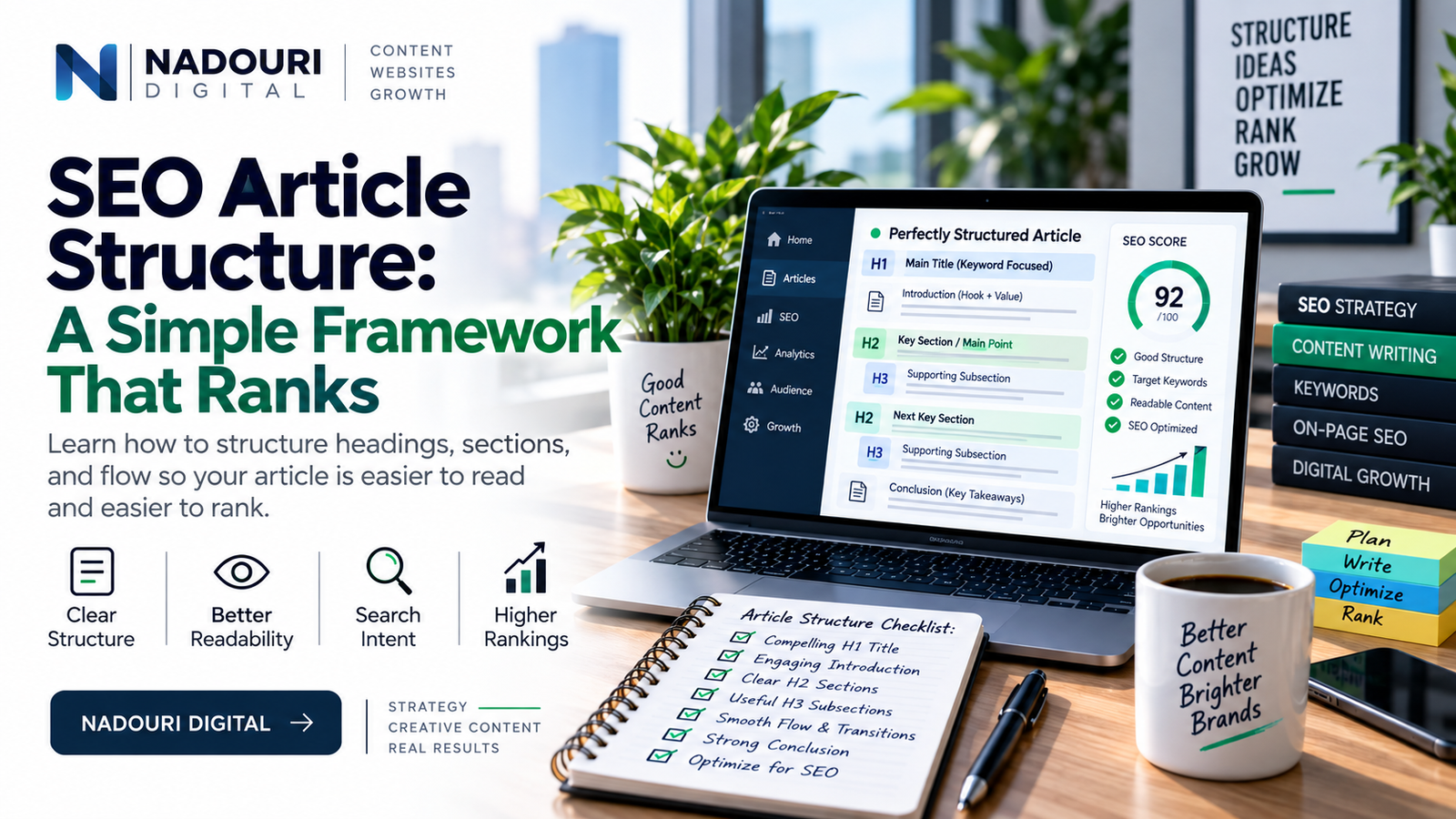
Why Structure Is a Ranking Factor
Google does not read articles the way people do — it parses them. Heading hierarchy tells the algorithm which questions your page answers and which passages deserve featured snippets. Readers benefit the same way: most visitors scan headings before committing to a single paragraph. A disciplined structure serves both audiences at once.
The Template, Block by Block
This is the skeleton we apply to every client article, from 800-word FAQs to 3,000-word pillars:
- Title tag — under 60 characters, keyword near the front, benefit included
- H1 — one per page, keyword-rich, matches the search intent exactly
- Introduction — 80–120 words: the problem, the promise, the proof you can deliver it
- Table of contents — on long articles; improves UX and earns jump links in search
- H2 sections — one per major subtopic, each opening with a direct answer
- H3 subsections — steps, examples, tools, comparisons
- Lists and tables — wherever information is enumerable
- Conclusion — synthesis, not summary; ends in one clear call to action
Direct-Answer Openings
Every H2 should open with a sentence that answers the heading completely on its own. Google lifts these sentences into featured snippets and AI overviews; readers get value even when scanning. Write the answer first, then the explanation, then the example.
Weak: “There are many factors to consider when thinking about article length…” Strong: “Most competitive SEO articles land between 1,500 and 2,500 words — long enough to cover the topic completely, short enough to stay focused.” The second can be quoted by Google verbatim.
Snippet Targets and Formatting
Decide before drafting which sections target which snippet formats. Definition H2s get 40–60 word paragraph answers. Process H2s get numbered steps. Comparison H2s get a table. This pre-planning is why structured articles win snippets while longer, messier competitors do not.
Where the CTA Belongs
Commercial elements belong in the structure, not bolted on afterward. Place a soft contextual link to a relevant service page mid-article where the topic touches it, and a full call-to-action block after the conclusion. An article structured this way informs completely and still converts — the reader never feels sold to, because the offer arrives after the value.
Conclusion
Structure is the cheapest ranking advantage available: the same words, reorganized, perform measurably better. Save this template, apply it to your next article, and compare the Search Console data after ninety days. Every article from our SEO article writing service ships on exactly this skeleton — research, structure and optimization included.