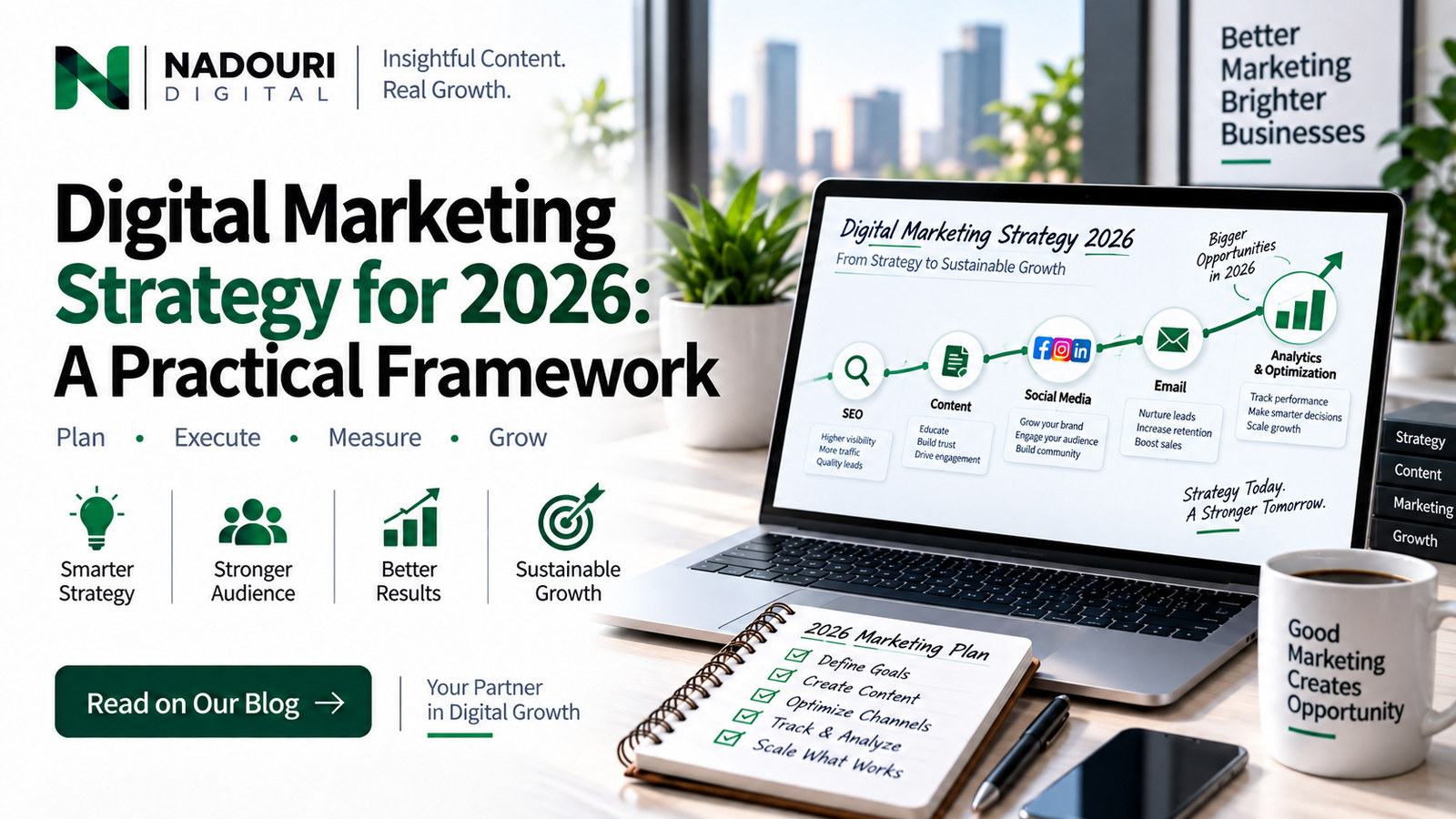
Strategy Is Choosing What Not to Do
Most small-business marketing fails from excess, not absence: seven channels run thinly, none with enough investment to work, all abandoned within a quarter for the next trend. Strategy is the discipline of concentration — choosing the few bets with the best evidence and funding them properly. A real strategy fits on one page and answers five questions; anything longer usually means the hard choices were avoided.
Decision One: Who Exactly Are We For?
“Small businesses” is not an audience; “e-commerce store owners doing $20–50k monthly who need product copy that converts” is. Precision here determines everything downstream — which channels reach them, which content they search for, which proof persuades them. Build the picture from your best current customers: what they do, what they fear, where they look for answers, and what finally made them buy. Marketing to a defined someone outperforms marketing to everyone at any budget.
Decision Two: Why Us and Not Them?
Positioning is the one-sentence answer a buyer needs: what you do, for whom, and the difference that matters. It is not a tagline; it is the claim every page, post and proposal reinforces. Weak positioning — “quality service at affordable prices” — forces you to compete on price. Strong positioning — “conversion copywriting for e-commerce, backed by tested results” — lets you compete on value. If your sentence could sit unchanged on a competitor’s site, it is not positioning yet.
Decision Three: Which Channels, Really?
Choose one compounding channel and one immediate channel, full stop. Compounding channels — SEO content, email, local SEO — build assets that grow while you sleep but take quarters to mature. Immediate channels — paid search, outreach, partnerships — produce this month’s pipeline but stop when spending stops. The pairing is the engine: immediate channels fund the wait while compounding channels build the future. Adding a third channel before the first two demonstrably work is how budgets die.
SEO content plus targeted outreach: articles compound in search while outreach produces near-term clients — and every new client becomes a case study that strengthens the content. The channels feed each other.
Decision Four: What Content Fuels It?
Content is not a channel; it is the fuel every channel burns. Define your content system on the same page: the three to five pillars you will own, the cornerstone assets that prove expertise, the cadence you can sustain for a year (sustainable weekly beats heroic daily), and the path from every piece of content to a business outcome — email signup, enquiry, sale. Content without a conversion path is publishing; content with one is marketing.
Decision Five: How Will We Know?
Close the page with measurement: three to five numbers reviewed monthly — pipeline generated, cost per acquisition by channel, organic visibility trend, email list growth, conversion rate. Each number needs an owner and a threshold that triggers action. The quarterly review re-asks all five questions with fresh evidence: strategies are not annual monuments but living hypotheses, revised on data.
Writing the One-Pager
Assemble the five decisions into a single page: audience definition, positioning sentence, chosen channels with budget split, content system with cadence, and the metric dashboard. Pin it where decisions get made. When a new opportunity appears — a platform, a tactic, a trend — the page answers whether it fits in seconds. That speed of consistent decision-making, sustained for a year, is what strategy actually buys.
Conclusion
Digital marketing strategy in 2026 is five decisions made honestly and reviewed quarterly: precise audience, sharp positioning, one compounding plus one immediate channel, a content system with conversion paths, and a handful of owned metrics. Simple to write, hard to hold, decisive when held. Nadouri Digital LLC powers the content engine at the center of that strategy — the articles, copy and campaigns the other four decisions depend on.