The Quality-Volume Trap
Every growing content operation hits the same wall: the founders’ early articles were excellent and slow; scaling means more writers, more volume — and immediately, drift. Voice fragments, standards slide, output rises while results fall. The trap is treating quality as a property of individual talent rather than of systems. Operations that scale successfully convert what their best writer does instinctively into documents, templates and gates any competent writer can follow.
The Brief Is the Quality Control Point
Nothing protects quality at scale like the brief, because most content failures are briefing failures. A production-grade brief contains:
- Target keyword and search intent — what the reader wants to achieve
- The unique angle — why this article deserves to exist over what already ranks
- Audience and stage — who reads this and what they already know
- Mandatory inclusions — specific expertise, examples, data points only your business has
- Structure requirements — target sections, format expectations
- Voice reference — links to two exemplary published pieces
- SEO requirements — internal links, meta specs, image and alt requirements
Templates and Playbooks
Recurring formats deserve documented playbooks: the case-study template, the how-to template, the comparison template. Each playbook captures the structure, the questions the writer must answer, and the quality bar — turning every assignment into a filling exercise with judgment, rather than an invention exercise from nothing. Templates are not creativity killers; they are the floor that lets writers spend creativity on substance instead of reinventing scaffolding.
The Editing Workflow That Holds the Line
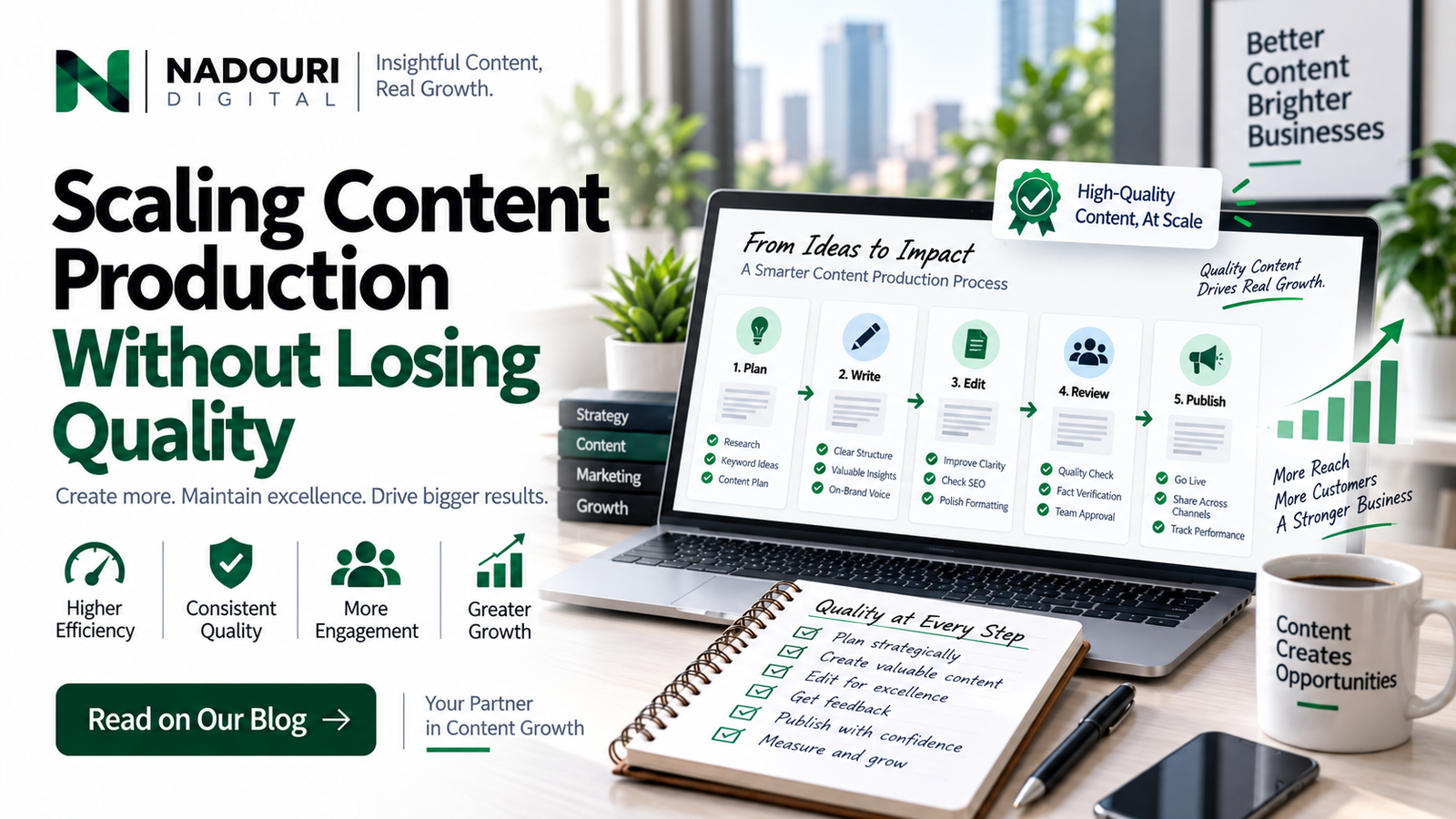
At scale, the editor becomes the most important role — the single throat through which everything passes. A workable editing pipeline runs three gates: structural edit (does it match the brief, intent and angle?), substance edit (are claims verified, examples real, advice sound?), and polish edit (voice, flow, formatting, SEO details). Small teams collapse these into one disciplined pass with a checklist. What cannot scale is skipping gates — unedited volume is exactly the pattern that erodes rankings and reputation together.
One agency reduced rewrites by two-thirds with a twelve-point pre-publication checklist: intent matched, facts verified, one H1, H2/H3 clean, internal links added, images optimized with alt, meta written, voice checked against reference piece. Twelve checks, five minutes, most failures caught.
Scaling With Writers, AI or Both
Three resourcing models scale content: more writers (highest ceiling, highest cost, management-heavy), AI-assisted in-house production (fast and cheap, demands rigorous verification), or an agency partner (variable cost, built-in systems, no hiring). Most growing businesses land on a blend — an agency or hybrid team for the volume and systems, internal experts contributing the irreplaceable input: the experience, data and opinions that make content worth reading. Scale the machinery around the expertise; never scale expertise out of the loop.
Measuring Whether Scaling Worked
Volume is not the metric; protected performance is. Watch per-article averages as output rises: rankings earned, organic traffic per article, engagement, conversion contribution. If averages hold or improve while volume doubles, the system works. If averages decay, you are scaling production of mediocrity — slow down and fix the gates. The goal is never more content; it is more content that performs.
Conclusion
Scaling content production is a systems problem: briefs that transfer judgment, templates that capture structure, editing gates that hold standards, and resourcing that keeps human expertise in the loop. Build the machine once and it produces quality at any volume. Nadouri Digital LLC operates exactly this machine for clients — scaled production with professional briefs, editing and accountability built in.